
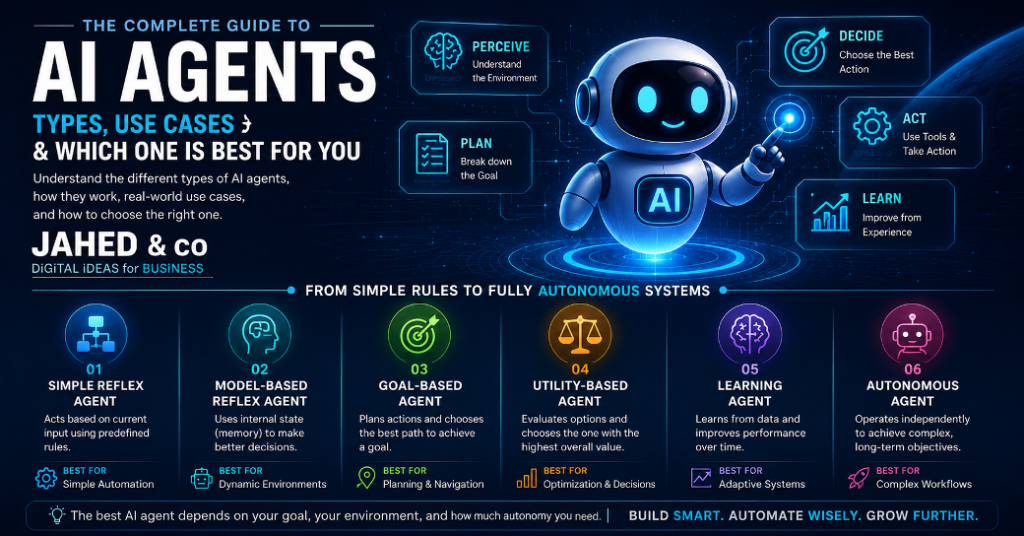
Artificial Intelligence is moving beyond simply answering questions.
Today, AI systems can understand information, make decisions, use tools, complete tasks, learn from experience, and even operate with limited human intervention.
These systems are commonly known as AI Agents.
But not every AI agent works in the same way. Some follow simple rules, while others can plan multiple steps, learn from their environment, use external tools, and work toward complex objectives.
So, how many types of AI agents are there—and which type is best for a particular job?
Let’s break it down.
What Is an AI Agent?
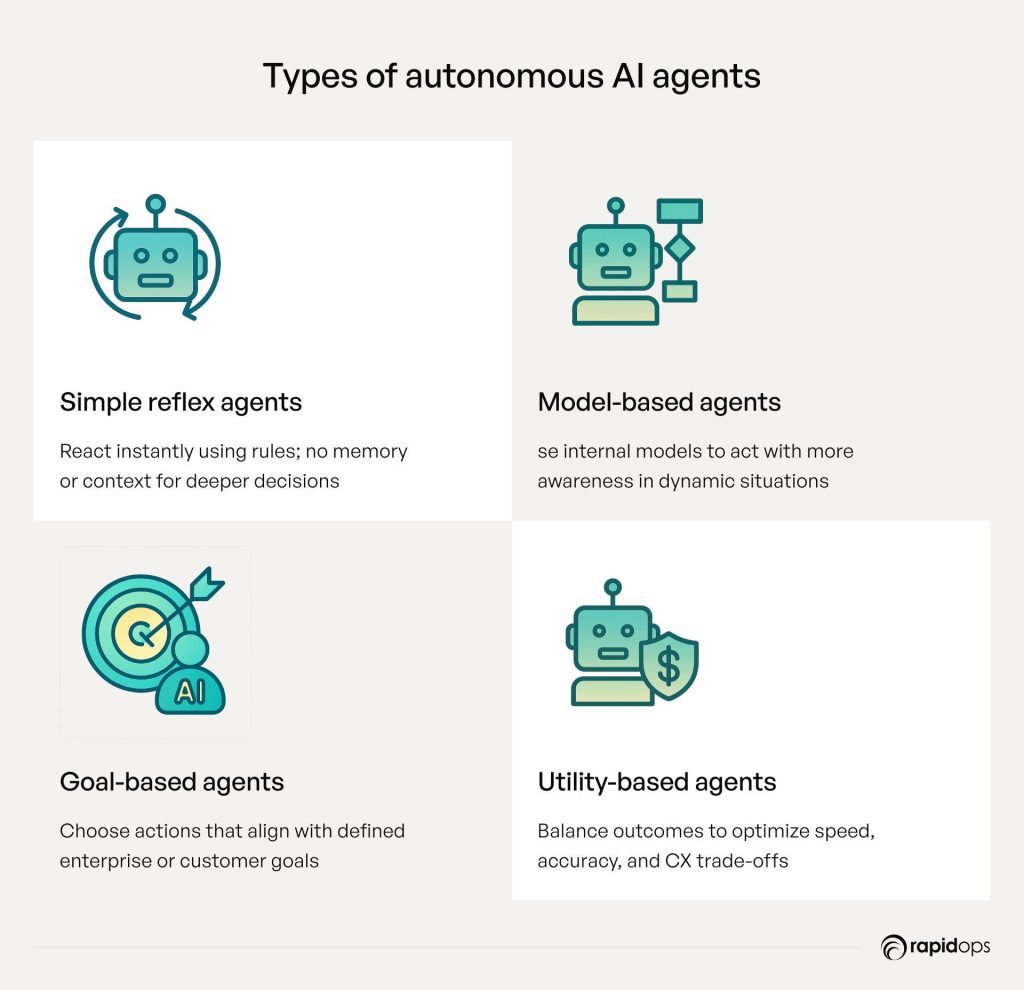
An AI agent is a software system that can perceive information, make decisions, and take actions to achieve a goal.
A traditional software program generally follows instructions:
Input → Rule → Output
An AI agent can work more dynamically:
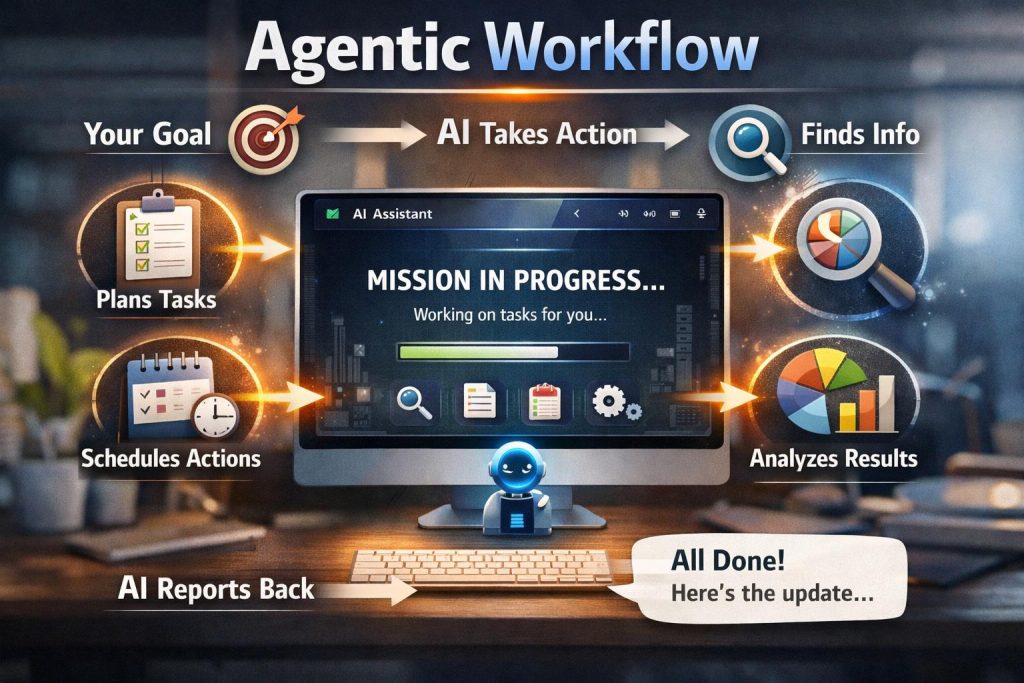
Observe → Understand → Decide → Act → Evaluate → Repeat
For example, imagine asking an AI agent:
“Find the best flight for my trip, compare the options, and prepare the itinerary.”
A simple chatbot may only tell you how to search for flights.
An AI agent could potentially:
- Understand your requirements
- Search available information
- Compare options
- Apply your preferences
- Select the best option
- Prepare an itinerary
- Ask for confirmation before making a purchase
The important difference is action and decision-making, not simply conversation.
The Main Types of AI Agents
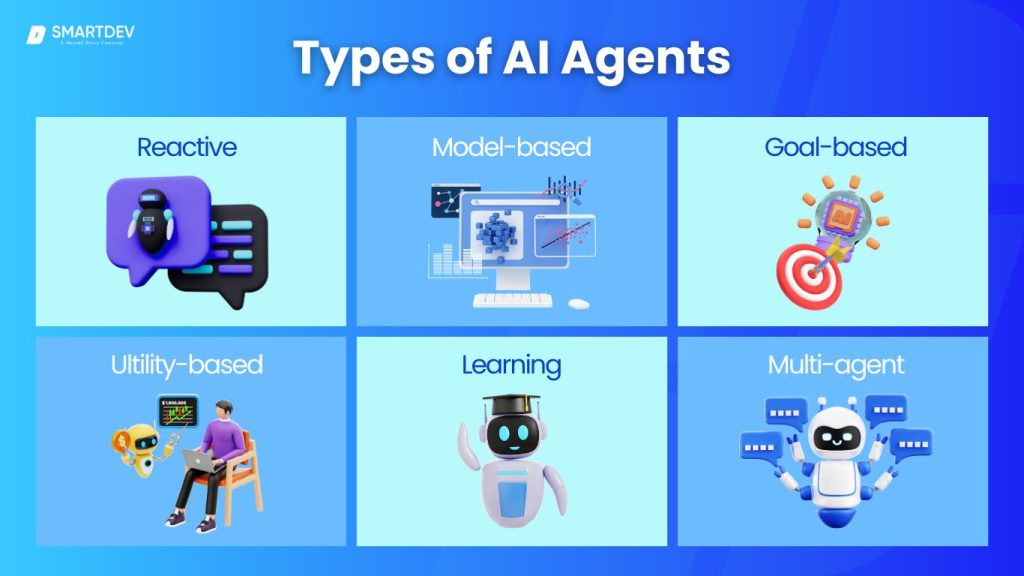
There isn’t one universally agreed number of AI-agent types. Different AI textbooks and modern AI frameworks classify agents differently.
A useful way to understand them is through six major categories.
1. Simple Reflex Agents
A Simple Reflex Agent makes decisions based primarily on the current situation.
It follows predefined rules such as:
IF this happens → DO this
Example
A smart air conditioner:
If temperature > 25°C → Turn cooling ON.
Or:
If motion is detected → Turn the light ON.
Best for
- Simple automation
- Sensors
- Alarms
- Smart-home devices
- Rule-based systems
- Predictable environments
Strength
Fast and predictable.
Limitation
It doesn’t have a sophisticated understanding of past events or long-term objectives.
2. Model-Based Reflex Agents
A Model-Based Reflex Agent goes a step further.
Instead of looking only at the current situation, it maintains an internal representation of the environment.
In simple terms, it can remember relevant information about what has happened.
For example, a robot may know:
- Where it is
- Where obstacles are
- What it previously observed
- What state the environment is in
This allows it to make better decisions when the entire environment isn’t visible at once.
Best for
- Robotics
- IoT systems
- Navigation
- Industrial automation
- Systems with changing environments
Strength
Can make decisions using both current information and internal state.
Limitation
It is still primarily reactive and may not perform sophisticated long-term planning.
3. Goal-Based Agents
Goal-Based Agents don’t simply react.
They ask:
“What action should I take to achieve my goal?”
The agent evaluates possible actions and selects actions that move it toward a desired outcome.
Example
A navigation system has a goal:
Reach Destination B.
It can evaluate different routes and select one that gets closer to the destination.
Another example could be an AI assistant whose goal is:
Prepare a business report by the end of the day.
The agent can break that objective into smaller tasks.
Best for
- Planning
- Navigation
- Scheduling
- Task management
- Problem solving
- Games
- Business workflows
Strength
Goal-oriented decision making.
Limitation
Reaching the goal isn’t always enough. Sometimes there are multiple ways to achieve it, and some are much better than others.
That’s where utility-based agents become useful.
4. Utility-Based Agents
A Utility-Based Agent considers not only:
“Can I achieve the goal?”
but also:
“Which option gives me the best overall result?”
The agent assigns value—or utility—to possible outcomes.
For example, suppose an AI needs to select a delivery route.
Three routes may all reach the destination:
- Route A: 30 minutes
- Route B: 40 minutes but cheaper
- Route C: 25 minutes but significantly more expensive
A utility-based system can consider multiple factors such as:
- Time
- Cost
- Risk
- Quality
- Customer satisfaction
and select the option that provides the best overall result.
Best for
- Recommendation systems
- Resource optimization
- Logistics
- Financial modelling
- Complex decision-making
- Scheduling
Strength
Balances multiple objectives.
Limitation
The system needs a sensible way to define and measure utility.
5. Learning Agents
A Learning Agent can improve its performance from experience or data.
Instead of relying entirely on fixed rules, it can adapt as it receives new information.
For example, a recommendation system may learn that a particular user frequently watches technology videos.
Over time, it can improve the recommendations it provides.
Best for
- Personalization
- Fraud detection
- Predictive systems
- Recommendation engines
- Adaptive applications
- Dynamic environments
Strength
Can improve over time.
Limitation
Learning systems require appropriate data, feedback, evaluation, and safeguards.
6. Autonomous AI Agents
Autonomous AI Agents represent the direction in which modern agentic AI is moving.
These systems can potentially:
- Understand a high-level objective
- Break it into smaller tasks
- Plan steps
- Use tools
- Execute actions
- Check results
- Adjust their approach
- Continue working toward the objective
For example, instead of asking:
“Write an email.”
you could give an agent a broader objective:
“Review these customer requests, identify urgent issues, prepare appropriate responses, and organize them for my approval.”
The agent could potentially perform multiple steps instead of simply generating one response.
Best for
- Business automation
- Research
- Software development
- Customer support
- Data analysis
- Workflow automation
- Complex multi-step tasks
Strength
High level of autonomy and multi-step task execution.
Limitation
Greater autonomy also means greater risk. Agents should have appropriate permissions, monitoring, validation, and human approval for important actions.
AI Agent Types at a Glance
| AI Agent Type | Best For | Main Capability |
|---|---|---|
| Simple Reflex | Basic automation | Rule-based reaction |
| Model-Based Reflex | Changing environments | Uses internal state |
| Goal-Based | Planning & objectives | Works toward goals |
| Utility-Based | Complex decisions | Chooses the most valuable outcome |
| Learning Agent | Adaptive systems | Learns and improves |
| Autonomous Agent | Complex workflows | Plans and acts with greater independence |
So, Which AI Agent Is Best?
There is no single best AI agent for everything.
The right choice depends on the problem.
Need simple automation?
Choose a Simple Reflex Agent.
Need to understand changing conditions?
A Model-Based Agent may be more suitable.
Need to reach a specific objective?
Use a Goal-Based Agent.
Need to compare multiple possible outcomes?
A Utility-Based Agent can be more appropriate.
Need the system to improve from experience?
Consider a Learning Agent.
Need multi-step automation with greater independence?
An Autonomous Agent may be the better approach.
What About Today’s Generative AI Agents?
Modern AI agents are increasingly combining several of these concepts.
A modern agent may use:
Large Language Model + Memory + Tools + Planning + Reasoning + Feedback + Actions
For example:
User Goal
↓
AI understands the request
↓
Creates a plan
↓
Uses tools/API
↓
Performs tasks
↓
Checks results
↓
Adjusts the plan
↓
Delivers the result
This is why the term “AI Agent” is becoming much broader than the traditional textbook classifications.
Modern agentic systems may combine goal-based behavior, utility-based decision-making, learning, tool use, and varying levels of autonomy.
AI Agent vs AI Chatbot
This distinction is important.
A chatbot generally focuses on conversation.
An AI agent focuses on achieving an objective through actions.
For example:
Chatbot:
“Here are five ways to create a business report.”
AI Agent:
“I collected the data, analyzed it, created the report, and prepared it for your review.”
The difference isn’t simply intelligence.
The key difference is the ability to plan, use tools, take actions, and work toward an objective.
The Future of AI Agents
AI agents could become an important layer between humans and software.
Instead of opening several applications and manually completing every step, users may increasingly communicate their desired outcome to an AI system.
For example:
“Prepare my weekly business summary.”
An agent could potentially gather information from authorized systems, analyze it, prepare the summary, and present it for approval.
This could change how people interact with:
- Business software
- Search engines
- Productivity tools
- Customer-service systems
- Data platforms
- Development environments
- Personal assistants
However, more autonomy does not automatically mean better AI.
For many tasks, a simple and predictable system is preferable to a highly autonomous one.
Final Thoughts
AI agents are not one single technology.
They range from simple rule-based systems to increasingly sophisticated systems capable of planning, learning, using tools, and completing multi-step objectives.
The best AI agent is therefore not necessarily the most advanced one.
The best agent is the one that matches the job.
For a simple task, keep it simple.
For complex problems, introduce planning, learning, tools, and autonomy only when they provide real value.
The future of AI may not simply be about building smarter models.
It may be about building smarter systems that can turn intelligence into useful action.
Quick Takeaway
Simple task → Simple Agent
Goal → Goal-Based Agent
Optimization → Utility-Based Agent
Learning → Learning Agent
Complex workflow → Autonomous Agent
AI doesn’t become truly useful only when it can answer a question. It becomes more powerful when it can understand a goal and responsibly take action to achieve it.
Author: Engr. Mohammad Jahed Hossain
Website: Jahed.co
Category: Artificial Intelligence